27% of Words Have No Perfect Rhymes
Overview
Words with no perfect rhymes are very widespread, and their distribution in the English vocabulary is non-random. This blog first covers methodology and accent. This is followed by a discussion of the two plots and a conclusion.
Methodology
For this analysis, all pronunciation data was for American English. Only perfect rhymes were considered. In other words, all of the rhymes were exact, and near rhymes, approximate rhymes, and multi-word rhymes excluded. Additionally, artistically altered pronunciations were excluded. This was a requirement for the analysis to work. While it might be debatable as to whether or not homonyms and homophones could be considered rhymes, they have been excluded. Relatively rare proper nouns are excluded as well. To produce the plots, Wikipedia-derived word frequency data was used in conjunction with an unabridged version of our rhyming dictionary.
Accent
Rhyming depends on a word's pronunciation, and pronunciation depends on accent. Within a particular country, pronunciations will vary, and no pronunciation is more correct than any other. This analysis is based on fairly good quality data. The results are applicable to a large number of American English speakers, but not for all of them. This is a limitation of the data. In short, rhymes will vary depending on accent.
The most common words with no rhymes
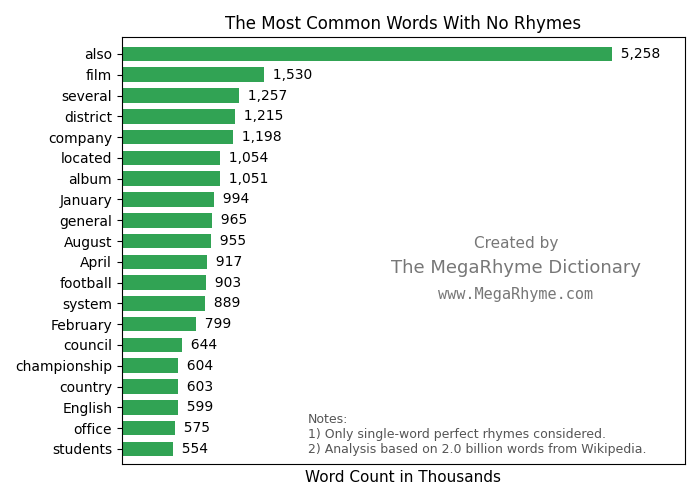
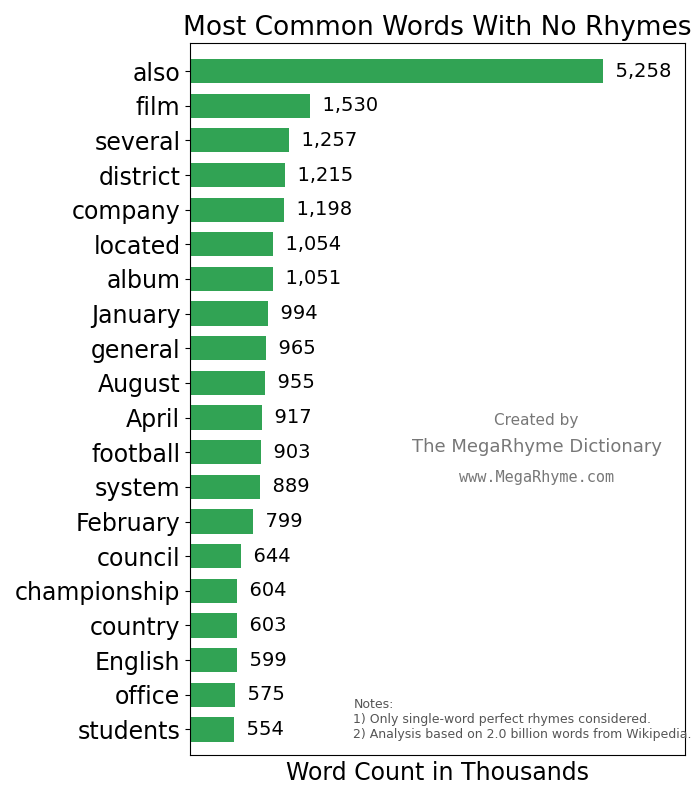
The most common words with no perfect rhymes are shown on the chart above. The numbers indicate the observed word count in the analyzed text. As a point of reference, the word "orange" had a count of 124,000, making it the 312th most common word with no exact rhymes.
Words with no rhymes are non-random
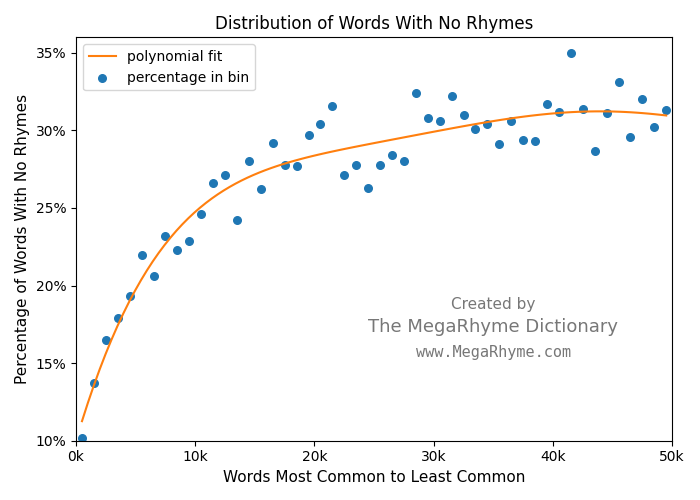
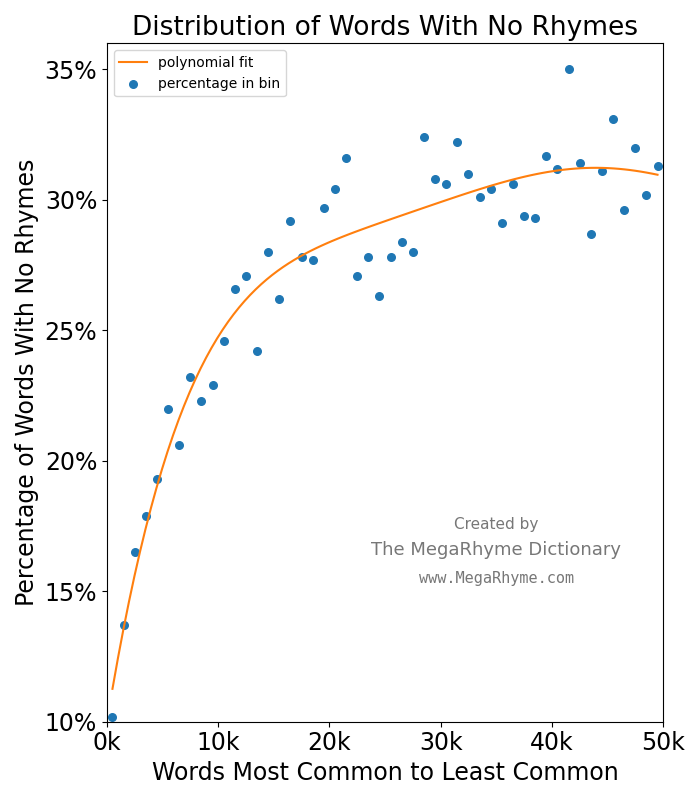
In addition to being plentiful, words with no rhymes are also distributed non-randomly in the word frequency data. To demonstrate this, we took a list of the 50,000 most common words and sorted it from most to least common. Among the first 1,000 words, 10.2% had no rhymes. While this amount is fairly high, the number grew as words became less common. Specifically, among the last 1,000 words, 31.3% had no rhymes. This relationship is illustrated more fully in the diagram below. Overall, 27.4% of words on the list had no rhymes.
Conclusion
Art isn't bound by rules. In fact, the practice of modifying word pronunciations to produce rhymes is widespread among songwriters. There's also a massive number of great sounding word pairs that aren't perfect rhymes. Our rhyming dictionary has long had options for finding half rhymes and approximate rhymes, and there's a reason for that.